Full Supply Reconciliation for Multi-Unit Developments
Water accountability in multi-unit developments requires more than individual sub-metering.
Smart Metering has expanded its leak detection platform with a new upstream reconciliation layer – delivering full visibility from the main supply meter through to every individual unit.
The Challenge
Sub-metering allocates usage to individual units.
However, it does not identify:
- Water lost between the main supply and individual meters
- Infrastructure leaks within the network
- Ongoing discrepancies that accumulate into significant costs
Without reconciliation at the boundary, unaccounted water can go unnoticed for months.
Our Dual-Layer Solution
Layer 1 – Individual Unit Monitoring (Downstream)
Each unit meter is monitored 24/7 for abnormal flow conditions.
The system:
- Detects continuous flow and threshold breaches
- Triggers automated alerts
- Enables early intervention before costs escalate
This protects against tenant-side leaks and internal plumbing faults.
Layer 2 – Main Supply Reconciliation (Upstream)
The new upstream layer continuously compares:
Main supply meter
vs
Aggregated unit consumption
This enables:
- Automated variance detection
- Configurable discrepancy thresholds
- Real-time tracking of unaccounted water
- Financial impact visibility via a live dashboard
If discrepancies exceed defined limits, alerts are triggered immediately.
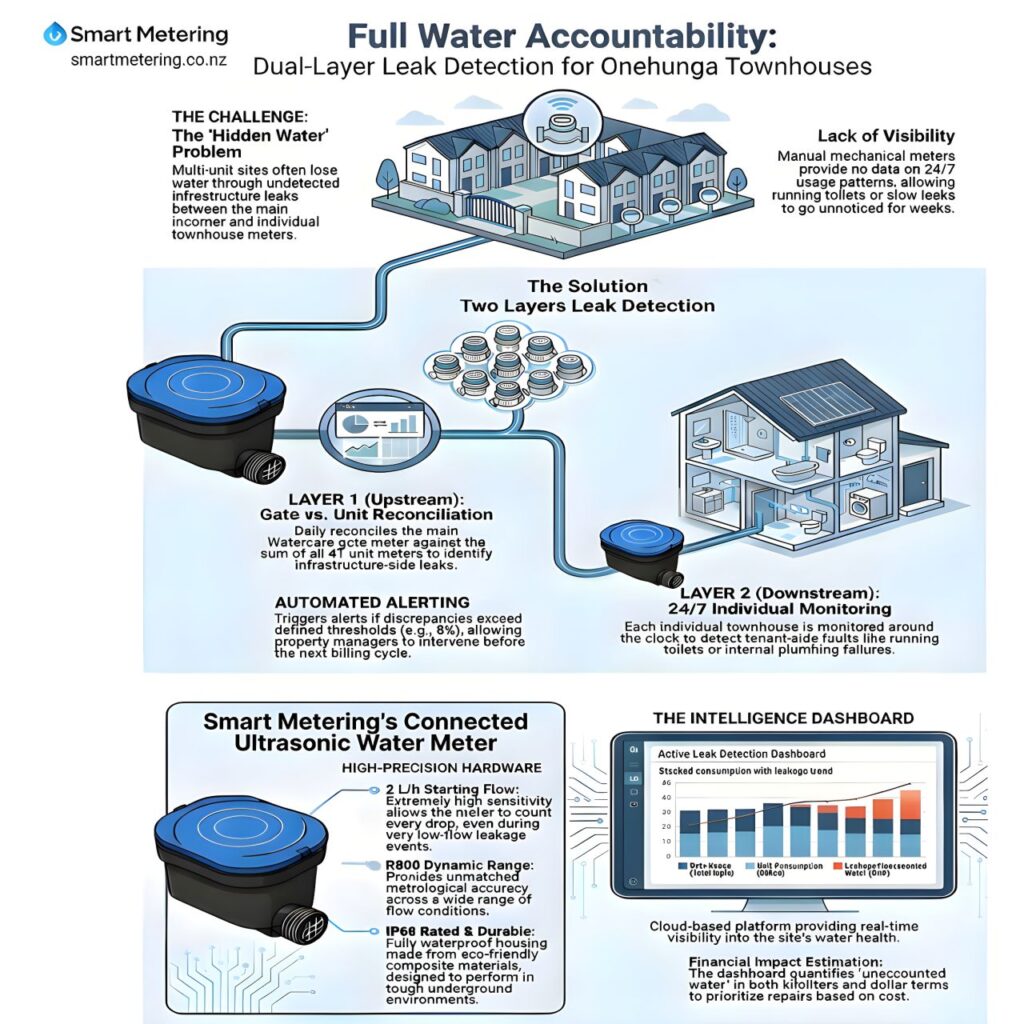
Live Deployment – Onehunga, Auckland
This dual-layer system is now live at a 41-townhouse development in Onehunga, Auckland.
The property team now has:
- Full upstream and downstream visibility
- Daily reconciliation of supply vs allocated usage
- Proactive infrastructure monitoring
- Real-time insight into financial exposure
Moving Beyond Billing
Smart Metering is evolving utility infrastructure from passive measurement to active intelligence.
By combining real-time monitoring, reconciliation analytics, and automated alerts, developments gain:
- Reduced financial risk
- Early leak detection
- Improved operational transparency
- Stronger long-term asset protection
Water reconciliation should be engineered into modern developments – not investigated after unexplained invoices.